
Keywords
Abstract
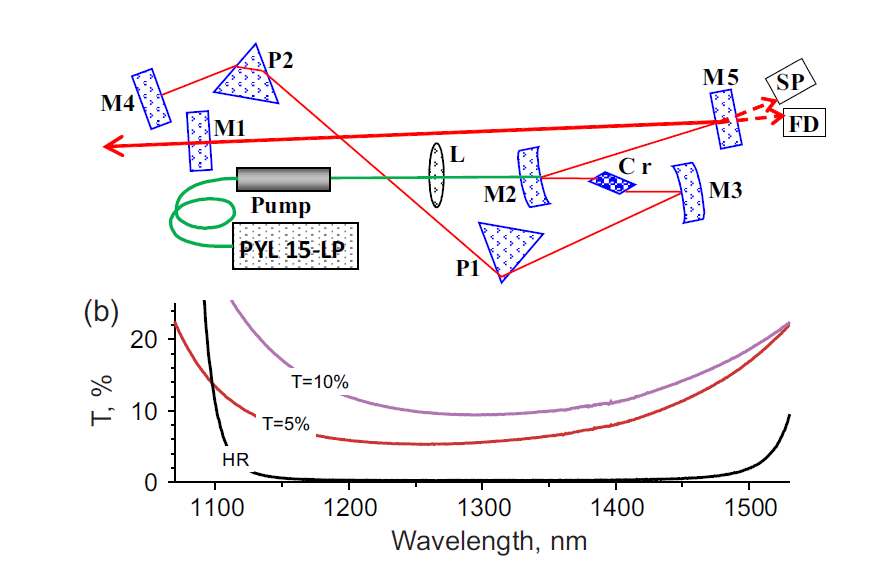
Increasing the efficiency and stability of femtosecond pulses generation in solid-state lasers has great significance for technological processes. At the same time, there is a need for research into a number of physical issues. The variable action of the instantaneous Kerr nonlinearity in the crystal, necessary for passive mode locking of the resonator, and the dispersion of the prisms, providing generation of ultrashort pulses, inevitably leads to regular perturbation of the shape of the generated pulses. In our work, we study the loss transformation regimes in a passive mode locking femtosecond laser pulses oscillator on a Mg2SiO4:Cr4+ crystal (chromium-forsterite) when the intracavity peak field power of the order of 2 MW, close to the critical self-focusing power. Analysis of the spectra and pulse durations in various parts of the cavity shows that the quasi-soliton pulse generation regime with the maximum peak power for the laser is supported by removing excess energy from the cavity through the generation of spectral Kelly sidebands and broadening the pulse spectrum beyond the gain of the active medium. A strong broadening of the pulse spectrum in the crystal upsets the balance of dispersive and nonlinear phase shifts and leads to deformation of the generated pulse shape. Additional passive losses arising due to nonlinear transformation in the crystal significantly reduce the efficiency of laser generation and limit peak power of the pulses.