
Keywords
Abstract
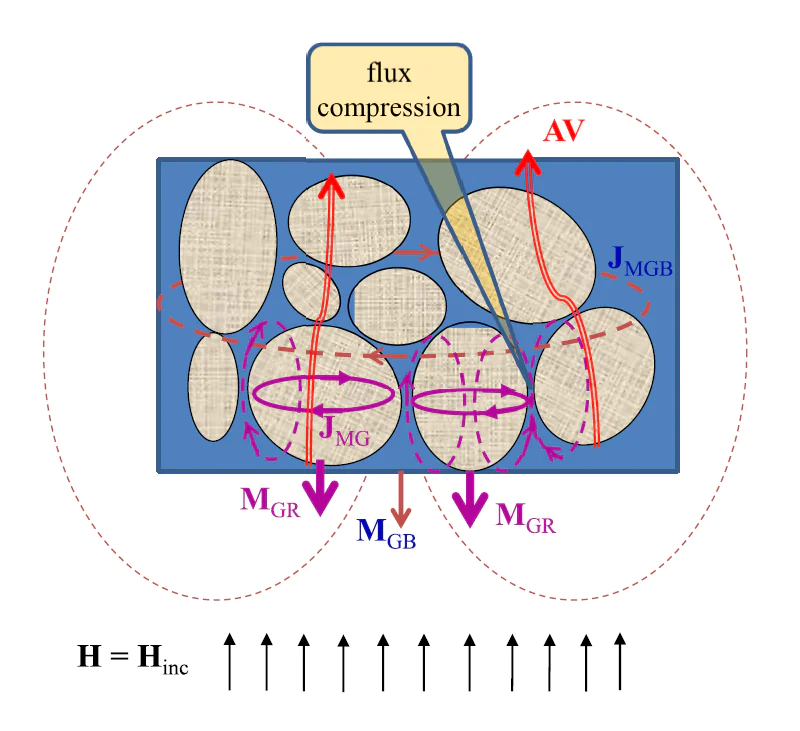
The evolution of the magnetic hysteresis loops of the granular high-temperature superconductor YBa2Cu3O7−δ with varying the maximum external applied field Hmax has been experimentally studied. In the range of weak fields (up to ∼10 Oe at a temperature of 78 K), the small hysteresis loop is observed, associated with diamagnetism and the penetration of Josephson vortices into the subsystem of intergranular boundaries, which is a Josephson medium. With further growth of Hmax, the larger magnetization hysteresis loop appears, associated with the penetration of Abrikosov vortices into superconducting granules. When analyzing the experimental data, a non-trivial fact was discovered: the magnetic response from the subsystem of intergranular boundaries becomes less noticeable with increasing Hmax, and at a certain value of Hmax this response disappears. This occurs even though the small hysteresis loop at small values of Hmax is comparable to the magnetic response of superconducting granules.
The described evolution of magnetic hysteresis is explained using the concept of an effective field in an intergranular medium. The total magnetic field in the subsystem of intergranular boundaries is determined not only by the external field, but also by closing fields from the magnetic moments of superconducting granules. In other words, the interaction between the superconducting subsystems of granules and intergranular boundaries leads to the small hysteresis loop in sufficiently small fields, and to its complete disappearance with increasing magnetization modulus of superconducting granules.