
Home / Publications / PREDICTION OF LOW-TEMPERATURE SILVER SULFIDE PHASES, DERIVATIVE FROM ARGENTITE

PREDICTION OF LOW-TEMPERATURE SILVER SULFIDE PHASES, DERIVATIVE FROM ARGENTITE

V Sadovnikov
V Sadovnikov
M.G. Kostenko 1
M.G. Kostenko
A.I. Gusev 1 *
A.I. Gusev
A.V. Lukoyanov 2, 3
A.V. Lukoyanov
1 Institute of Solid State Chemistry Ural Branch of Russian Academy of Sciences
2 Mikheev Institute of Metal Physics, Ural Branch of the Russian Academy of Sciences
3 First President of Russia Boris Yeltsin Ural Federal University
Published 2023-10-20
Share
Cite this
GOST
 | 
Cite this
GOST Copy
Sadovnikov V. et al. PREDICTION OF LOW-TEMPERATURE SILVER SULFIDE PHASES, DERIVATIVE FROM ARGENTITE // Journal of Experimental and Theoretical Physics. 2023. Vol. 165. No. 3. pp. 374-389.
GOST all authors (up to 50) Copy
Sadovnikov V., Kostenko M., Gusev A., Lukoyanov A. PREDICTION OF LOW-TEMPERATURE SILVER SULFIDE PHASES, DERIVATIVE FROM ARGENTITE // Journal of Experimental and Theoretical Physics. 2023. Vol. 165. No. 3. pp. 374-389.
RIS
 | 
Cite this
RIS Copy
TY - JOUR
DO - 10.31857/S00444510240307e1
UR - https://jetp.colab.ws/publications/10.31857/S00444510240307e1
TI - PREDICTION OF LOW-TEMPERATURE SILVER SULFIDE PHASES, DERIVATIVE FROM ARGENTITE
T2 - Journal of Experimental and Theoretical Physics
AU - Sadovnikov, V
AU - Kostenko, M.G.
AU - Gusev, A.I.
AU - Lukoyanov, A.V.
PY - 2023
DA - 2023/10/20
PB - Nauka Publishers
SP - 374-389
IS - 3
VL - 165
ER -
BibTex
 | 
Cite this
BibTex (up to 50 authors) Copy
@article{2023_Sadovnikov,
author = {V Sadovnikov and M.G. Kostenko and A.I. Gusev and A.V. Lukoyanov},
title = {PREDICTION OF LOW-TEMPERATURE SILVER SULFIDE PHASES, DERIVATIVE FROM ARGENTITE},
journal = {Journal of Experimental and Theoretical Physics},
year = {2023},
volume = {165},
publisher = {Nauka Publishers},
month = {Oct},
url = {https://jetp.colab.ws/publications/10.31857/S00444510240307e1},
number = {3},
pages = {374--389},
doi = {10.31857/S00444510240307e1}
}
MLA
Cite this
MLA Copy
Sadovnikov, V., et al. “PREDICTION OF LOW-TEMPERATURE SILVER SULFIDE PHASES, DERIVATIVE FROM ARGENTITE.” Journal of Experimental and Theoretical Physics, vol. 165, no. 3, Oct. 2023, pp. 374-389. https://jetp.colab.ws/publications/10.31857/S00444510240307e1.
Views / Downloads
4 / 32

Keywords

crystal structure predictions
elastic constants
electronic structure
formation enthalpy
mechanical stability
silver sulfide

Abstract

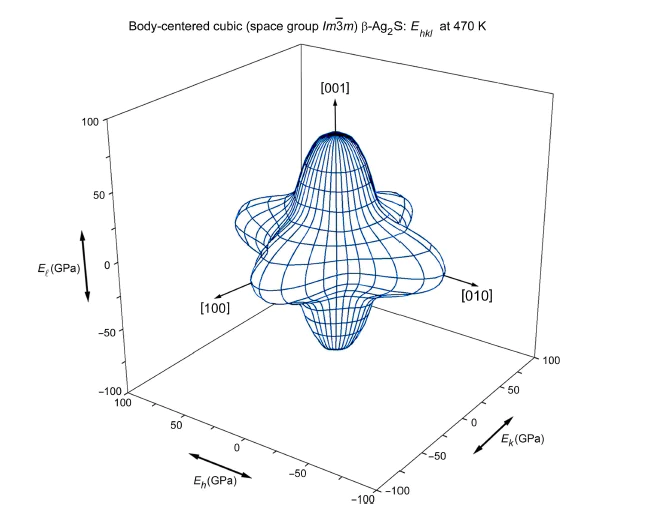
Such phases of silver sulfide as body-centered cubic argentite and monoclinic acanthite are widely known. Traditionally, acanthite is considered as the only low-temperature phase of silver sulfide. Low-temperature monoclinic acanthite can be considered as a result of the ordering of sulfur atoms in a non-metallic volume-centered cubic sublattice of argentite, accompanied by a redistribution of silver atoms. However, the possible existence of other low-temperature phases of silver sulfide cannot be excluded. The search for the model phases of the silver sulfide was performed using an evolutionary algorithm. The possibility of the formation of Ag2S phases with cubic, tetragonal, orthorhombic, trigonal, monoclinic and triclinic symmetries is considered. The calculation of the cohesion energy and enthalpy of formation showed that the formation of low-symmetry phases of Ag2S is energetically most favorable. The elastic stiffness constants cij of all predicted phases of Ag2S are calculated and their mechanical stability is determined. The electron state densities of the predicted Ag2S phases are calculated. Channels of disorder-order transitions associated with the formation of low-temperature unrelaxed monoclinic acanthite ɑ- Ag2S and cubic (space group Pn3m) silver sulfide Ag2S from disordered argentite have been found. The spatial distributions of Young’s modulus and comprehensive compression of cubic (space group Pn3m) silver sulfide Ag2S are determined and a weak anisotropy of its elastic properties is established.

The bibliography includes 33 references.

[1-33]

References

1.
R. C. Sharma and Y. A. Chang, Bull. Alloy Phase Diagrams 7, 263-269 (1986).
2.
W. T. Thompson and S. N. Flengas, Can. J. Chem. 49, 1550-1563 (1971).
3.
S. I. Sadovnikov, A. I. Gusev, and A. A. Rempel, Phys. Chem. Chem. Phys. 17, 12466-12471 (2015).
4.
R. Sadanaga and S. Sueno, Mineralog. J. Japan. 5, 124-148 (1967).
5.
S. I. Sadovnikov and A. I. Gusev, J. Mater. Chem. A 5, 17676-17704 (2017).
6.
S. I. Sadovnikov, A. I. Gusev, and A. A. Rempel, Phys. Chem. Chem. Phys. 17, 20495-20501 (2015).
7.
O. Alekperov, Z. Jahangirli and R. Paucar, Phys. stat. sol.(b) 253, 1-7 (2016).
8.
S. Kashida, N. Watanabe, T. Hasegawa, H. Iida, M. Mori, and S. Savrasov, Sol. State Ionics 158, 167- 175 (2003).
9.
S. F. Etris, In Kirk-Othmer Encyclopedia of Chemical Technology, Metals and Alloys, Wiley, New York (2001), vol. 4, pp.761-803.
10.
Universal Structure Predictor: Evolutionary Xtallography. Manual. Version 9.4.4 (http://uspex-team.org)
11.
A. R. Oganov and C. W. Glass, J. Chem. Phys. 124, paper 244704 (2006).
12.
A. R. Oganov, A. O. Lyakhov, and M. Valle, Accounts Chem. Res. 44, 227-237 (2011).
13.
A.O. Lyakhov, A. R. Oganov, H. T. Stokes, Q. Zhu, Comp. Phys. Comm. 184, 1172-1182 (2013).
14.
W. Kohn and L. J. Sham, Phys. Rev. 140, A1133-A1138 (1965).
15.
J. P. Perdew, K. Burke, and M. Ernzerhof, Phys. Rev. Lett. 77, 3865-3868 (1996).
16.
G. Kresse and D. Joubert, Phys. Rev. B 59, 1758-1775 (1999).
17.
G. Kresse and J. Furthmüller, Comput. Mater. Sci. 6, 15-50 (1996).
18.
Vienna Ab-initio Simulation Package. VASP the GUIDE. April 20, 2016 (http://cms.mpi.univie.ac.at/ VASP/)
19.
P. E. Blöchl, O. Jepsen, and O. K. Andersen, Phys. Rev. B 49, 16223-16233 (1994).
20.
Y. Hinuma, G. Pizzi, Y. Kumagai, F. Oba, and I. Tanaka, Comp. Mater. Sci. 128, 140-184 (2017).
21.
F. Mouhat and F-X. Coudert, Phys. Rev. B 90, paper 224104 (2014).
22.
K. Momma and F. Izumi, J. Appl. Crystallogr. 44, 1272-1276 (2011).
23.
S. I. Sadovnikov, A. I. Gusev, and A. A. Rempel, Superlat. Microstr. 83, 35-47 (2015).
24.
A. I. Gusev, A. A. Rempel, and A. J. Magerl, Disorder and Order in Strongly Nonstoichiometric Compounds. Transition Metal Carbides, Nitrides and Oxides, Springer- Verlag, Berlin – Heidelberg - New York (2001). 608 pp.
25.
O. V. Kovalev, Irreducible Representations of the Space Groups, Gordon & Breach, New York (1965). 210 pp.25.
26.
A. I. Kryukov, O. L. Stroyuk, N. N. Zin’chuk, A. V. Korzhak, and S. Ya. Kuchmii, J. Mol. Catal. A 221, 209-221 (2004).
27.
S. I. Sadovnikov, Yu. V.Kuznetsova, and A. A. Rempel, Nanostr. Nano-Object. 7, 81-91 (2016).
28.
Q. Liu, Y. Pu, Zh. Zhao, J. Wang, and D. Wang, Transact. Tianjin Univ. 26, 273-282 (2020).
29.
O. V. Kovalev, Representations of the Crystallographic Space Groups: Irreducible Representations, Induced Representations and Corepresentation, Gordon & Breach Science Publ., Yverdon - Paris – Berlin - London – Tokyo – Amsterdam (1993). 2nd ed. 390 pp. https://matrix.reshish.ru
30.
M. Born, Math. Proc. Camb. Phil. Soc. 36, 160-172 (1940).
31.
R. E. Newnham, Properties of Materials. Anisotropy, Symmetry, Structure, Oxford Univ. Press, New York (2005). P.109-113.
32.
T. Gnäupel-Herold, P. C. Brand, and H.J. Prask, J. Appl. Crystallogr. 31, 929-935 (1998).
33.
C. Zener, Elasticity and Anelasticity of Metals, University of Chicago, Chicago (1948). 170 pp.